
Reviewed · GDANSK BIKE & E-BIKE TOURS
Bike Tour Gdansk – Standard
Gdańsk clicks into place on two wheels. This short, local-led ride is a practical way to see the best monuments and explain what they mean, including the Solidarność story that shaped modern Poland. I especially like the calm pace and the fact it’s customizable to your interests, so you can spend a little more time on the parts that grab you.
Two stops really make the tour feel worth it: St. Mary’s Church with Memling’s The Last Judgment, and the Europejskie Centrum Solidarności plus the Gdańsk Shipyard, which connect the city’s fame to the Solidarity movement. One possible drawback: with only about 2 hours, each place gets a quick highlight, and some key sites have admission fees you’ll pay separately.
In This Review
- Key highlights that make this Gdańsk bike tour a smart pick
- Why biking Gdańsk helps you get oriented fast
- Your 2-hour route: from Dluga Street to Wyspa Spichrzów
- Stop 1: Gdańsk Dluga Street (Neptune’s Fountain and the Town Hall)
- Stop 2: St. Mary’s Church (Memling’s triptych and the astronomical clock)
- Stop 3: Europejskie Centrum Solidarności (why it matters to Polish people)
- Stop 4: Gdańsk Shipyard (Solidarity and the fall of communism)
- Stop 5: Museum of the Second World War (quick orientation, ticket not included)
- Stop 6: Golden Gate (Zlota Brama) and its allegorical statues
- Stop 7: Wyspa Spichrzów (historical heart destroyed during WWII)
- Stop 8: Kladka nad Motławą na Olowiankę (if it’s open, you go)
- Stop 9: Crane (one of Gdańsk’s defining symbols)
- Stop 10: Green Gate (Brama Zielona)
- Solidarity landmarks: understanding the story instead of just seeing buildings
- St. Mary’s Church: a highlight stop that rewards your attention
- Reading the city’s symbols: Golden Gate, gates, crane, and river views
- Price and value: what $43.05 buys in a 2-hour city overview
- Logistics that actually affect your ride
- Who this bike tour fits best
- Should you book Bike Tour Gdansk – Standard?
- FAQ
- How long is the Bike Tour Gdansk – Standard?
- Where does the tour start and end?
- Is this tour private?
- Can I customize the tour to my interests?
- Is a mobile ticket included?
- Do entrance tickets cost extra?
- What are the main stops on the route?
- Is the tour dependent on weather?
- What is the cancellation policy?
- Is it suitable for most travelers?
Key highlights that make this Gdańsk bike tour a smart pick
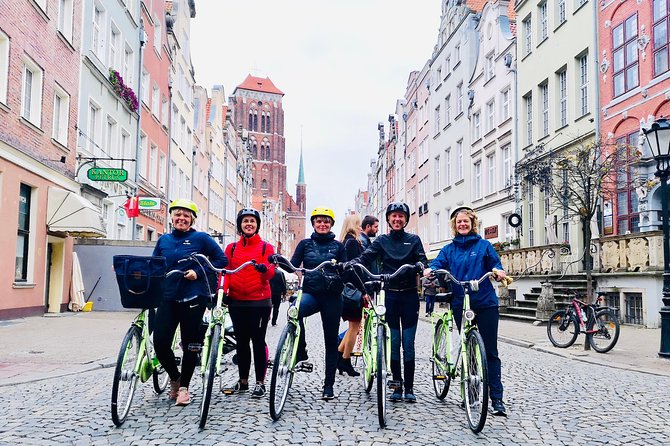
- Local-led, customizable route that adapts to what you want to focus on
- St. Mary’s Church included, where you’ll spot Memling’s triptych The Last Judgment and other standout details
- Solidarity stops with context, linking Europejskie Centrum Solidarności to the Gdańsk Shipyard story
- Old-town icons in a tight loop, including Neptune’s Fountain, the Golden Gate, the Crane, and gates over the river
- A mix of included and not-included entrances, so you can plan for extra tickets where needed
Why biking Gdańsk helps you get oriented fast
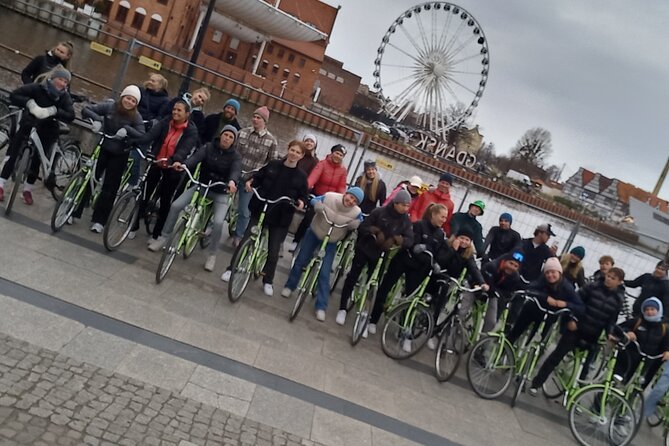
Gdańsk is the kind of city where walking is nice, but time disappears fast. A bike tour solves that problem by letting you cover more ground while still moving at a comfortable pace. You get the feel of the city without turning it into a sprint.
What I like about this style of tour is that it’s designed as an overview, not a checklist. In roughly two hours, you can see the major landmarks that define Gdańsk’s identity, then decide what deserves deeper time later.
And because it’s led by a local, you’re not just looking at buildings and sculptures. You’re getting the meaning behind them, including the Polish traditions and the local way of thinking that show up around the places tied to modern history.
More Gdansk bike and e-bike tours along the waterfront


Your 2-hour route: from Dluga Street to Wyspa Spichrzów
This tour is built as a highlight loop starting and ending at Kołodziejska 7. Expect quick stops—often around 5 to 10 minutes—so your guide can move you to the next icon without losing the thread of the story.
Here’s what you’ll do, stop by stop, and what to watch for.
Stop 1: Gdańsk Dluga Street (Neptune’s Fountain and the Town Hall)
You start on Dluga Street, where the big public-life landmarks sit close together. Neptune’s Fountain and the nearby Town Hall area give you a fast taste of the city’s historic center.
This first stop is more about orientation than details. Use it to get a mental map of where you are before the tour shifts into churches, gates, and the Solidarity story.
Stop 2: St. Mary’s Church (Memling’s triptych and the astronomical clock)
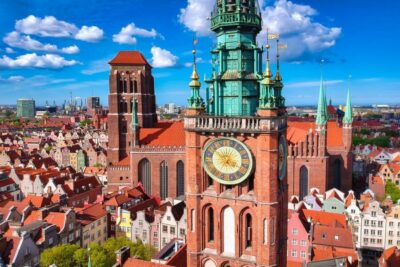
St. Mary’s Church is one of the strongest “included” moments of the ride. You’ll get to see Memling’s triptych The Last Judgment, the Beautiful Madonna sculpture, and a basket chandelier from 1490. The church also features the famous mentioned astronomical clock.
With only about 10 minutes here, focus on highlights your eye catches first: the triptych, the Madonna sculpture, and the astronomical clock area. If you want a slower visit later, this stop helps you know what to return for.
Stop 3: Europejskie Centrum Solidarności (why it matters to Polish people)
Next comes Europejskie Centrum Solidarności, explained as a key place for Polish people. This is where the tour’s historical theme stops being abstract and starts feeling personal.
The value here isn’t only the building—it’s the framing: you’ll learn why this site carries weight in Poland. If you care about 20th-century politics, this is one of the most meaningful stops on the route.
- Gdańsk City Sights & History Guided Walking Tour in English
★ 4.8 · 876 reviews - Gdansk: Firearm Shooting Experience with Instructor
★ 4.8 · 866 reviews - Gdansk: Guided Round-Trip Cruise to Westerplatte
★ 4.3 · 865 reviews - Gdańsk: Sightseeing EcoCruise around the Old Town of Gdansk
★ 4.6 · 719 reviews
Stop 4: Gdańsk Shipyard (Solidarity and the fall of communism)
Then you move to the Gdańsk Shipyard, a major Polish shipyard with international fame tied to the Solidarity movement and the collapse of the communist system. This stop ties the story to a place tied to work, industry, and major turning points.
The pace is brisk, so don’t expect a long museum-style visit. Instead, treat this as a connection point: what you learned at the Solidarity center becomes clearer when you stand near the shipyard context.
Stop 5: Museum of the Second World War (quick orientation, ticket not included)
You’ll also make a stop at the Museum of the Second World War, and it’s marked as a “visit necessarily” type of stop. Admission is not included, so this is more of a strategic overview than a full entry.
If you’re curious, this is a great “decision moment.” After the ride, you’ll know whether you want to buy your own ticket for a deeper visit.
Stop 6: Golden Gate (Zlota Brama) and its allegorical statues
At Golden Gate (Zlota Brama), you’ll spot the allegorical statues representing virtues like Peace, Freedom, Wealth, Fame, Piety, Justice, and Concord. It’s a short stop, but it teaches you how to read the artwork as values, not just decoration.
If you like symbolic architecture, you’ll enjoy this more than you’d expect from a quick gate photo stop.
Stop 7: Wyspa Spichrzów (historical heart destroyed during WWII)
Wyspa Spichrzów is described as the historical heart of Gdańsk, and it was destroyed during World War II. That fact adds emotional weight to even a short stop here.
In about 5 minutes, you won’t get the full story, but you will leave with a key understanding: this “heart” was not just preserved—it was reshaped. If you’re sensitive to war-related history, keep your expectations realistic: this is a highlight, not a full account.
Stop 8: Kladka nad Motławą na Olowiankę (if it’s open, you go)
There’s a flexible stop at Kladka nad Motławą na Olowiankę. If it’s open, you’ll cross or at least make use of the crossing for views.
This is one of those “depends on conditions” parts, so it’s smart to stay flexible. When it works, it breaks up the sightseeing rhythm with a slightly different perspective.
Stop 9: Crane (one of Gdańsk’s defining symbols)
The Crane is one of the defining symbols of Gdańsk. Even though admission isn’t included, the stop is short enough that you can quickly orient your photos: you know what this symbol represents in the city’s image.
Use this moment for a classic skyline shot. The crane is often a visual anchor, and you’ll see it echoed in how people talk about the city.
Stop 10: Green Gate (Brama Zielona)
Finally, you reach Green Gate (Brama Zielona), which leads to the Green Bridge. It’s another symbol-heavy stop, and the short timing keeps the tour from dragging.
If you want the route to end with a satisfying “wrap-up” feeling, this last stretch does that job.
Solidarity landmarks: understanding the story instead of just seeing buildings
Two stops in this ride are tightly linked: Europejskie Centrum Solidarności and the Gdańsk Shipyard. The tour frames them as part of the same bigger arc: Solidarity’s rise and the collapse of the communist system.
The way it’s taught matters. Instead of only pointing at walls or exhibits, you get a guided explanation of why these places hit hard for Polish people. That context is the difference between seeing something and actually understanding why it matters.
One useful tip for you: when the guide switches from the Solidarity center to the shipyard area, listen for the “connection words.” That’s where your mental timeline locks in—how a movement can reshape a city’s role, economy, and identity.
Also, expect a strong emphasis on the 1980s Solidarity period, which is a theme that stands out in the way this tour is described. If that era is on your interest list, this is likely the best part of the whole route.
St. Mary’s Church: a highlight stop that rewards your attention
St. Mary’s Church is one of the main reasons to consider this tour. The highlight is Memling’s triptych The Last Judgment, which is named as a key work you’ll see. On top of that, you’ll also get Beautiful Madonna, a basket chandelier from 1490, and the church’s astronomical clock.
With only about 10 minutes, the tour’s approach is to make sure you don’t miss the obvious anchors. That’s good for first-timers because it teaches you what matters most—without requiring hours.
For you, the practical move is simple: decide what you care about most in advance. Are you drawn to religious art, technical clock features, or historic details like the 1490 chandelier? You can use your energy where it counts, and if you want more later, you’ll know exactly what to target.
Reading the city’s symbols: Golden Gate, gates, crane, and river views
Some cities are easy to understand because the symbols are loud. Gdańsk’s symbols are built into gates, sculptures, and waterfront landmarks.
At Golden Gate (Zlota Brama), you’ll learn the meaning of the allegorical statues: Peace, Freedom, Wealth, Fame, Piety, Justice, and Concord. That’s not just trivia. It gives you a way to interpret what you’re looking at, even on a quick stop.
Then there’s the Crane, described as one of the defining symbols of Gdańsk. It’s a classic visual landmark, and it’s the kind of thing that makes photos instantly recognizable.
Finally, the river crossings and nearby gateways help you “feel” the city’s layout. If Kladka nad Motławą na Olowiankę is open, that stop adds a different angle—an easy way to change how you see the waterfront without adding extra time.
Price and value: what $43.05 buys in a 2-hour city overview
At about $43.05 per person for roughly 2 hours, this isn’t an all-day “everything” tour. It’s a focused overview that aims to give you key landmarks plus the explanations that connect them.
Here’s the value logic I’d use as you decide:
- You’re paying for a local-led route that connects major icons with a clear theme, especially Solidarity and the modern history of the city.
- Some entrances are included at major stops, including St. Mary’s Church, Europejskie Centrum Solidarności, Gdańsk Shipyard, Wyspa Spichrzów, and Kladka nad Motławą na Olowiankę.
- Other notable stops have admissions not included, including the Museum of the Second World War, plus entrances are listed as not included for places like Neptune’s Fountain/Town Hall area, Golden Gate, Crane, and Green Gate.
So the “extra cost” risk is real if you decide on your own to enter the Museum of the Second World War during or after the tour. But the upside is that the tour helps you decide quickly where you want deeper time.
One more practical note: this is listed as private, meaning only your group participates. That typically means less waiting and fewer distractions, which matters when you only have a couple hours to cover a lot.
And because it’s an activity that’s often booked around 21 days in advance, getting your spot earlier can help if your schedule is tight.
Logistics that actually affect your ride
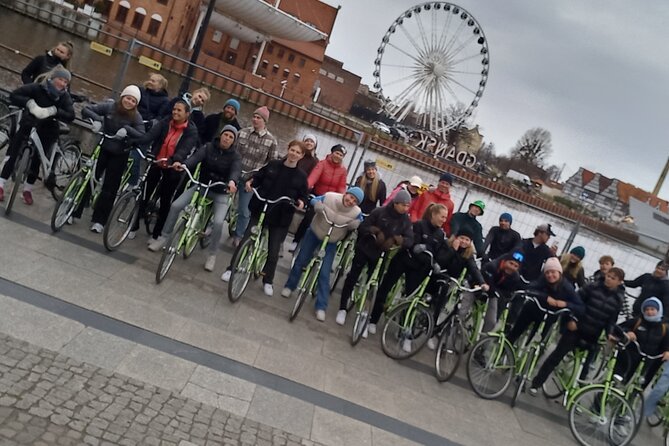
This tour starts and ends at Kołodziejska 7, 80-836 Gdańsk. It’s designed as an easy loop rather than an out-and-back to far corners.
It also runs on the reality of weather. It requires good weather, and if it’s canceled due to poor weather, you’ll be offered a different date or a full refund. Since bike tours depend on conditions, your best plan is to avoid treating it like a guaranteed “just in case” day.
Timing is another factor. Stops are short—often around 5 minutes, sometimes 10—so come with curiosity rather than strict expectations for long museum time. You’ll get the highlights and the meaning, then you can follow up later on what you care about most.
Lastly, you’ll get a mobile ticket, and you’ll receive confirmation at booking time. That’s handy when you’re bouncing between sites in the same day.
Who this bike tour fits best
This tour fits well if you:
- Want an efficient overview of Gdańsk’s most recognized landmarks in about two hours
- Care about understanding the Solidarity-era connection to the city, not just taking photos
- Like the idea of a local guide explaining Polish culture and local perspective
- Prefer a paced sightseeing plan with a relaxing bike rhythm instead of sprinting on foot
It may not be your best match if you want slow, deep museum time at each stop. This ride is built for highlights. If you love reading every plaque and lingering in galleries, plan to extend your visit after the tour.
Should you book Bike Tour Gdansk – Standard?
If you want a fast, meaningful Gdańsk orientation that includes both the pretty icons and the emotionally weighty Solidarity story, I think this is a strong yes. The combination of St. Mary’s Church (with Memling’s The Last Judgment) and the Solidarity-linked stops gives the tour real substance for the time you spend.
Book it if you like guided context, you’re okay with short stops, and you want to leave the city with a clear mental map. Skip it if your top priority is long museum exploration during this same outing, since admissions vary and most stops are intentionally brief.
FAQ
How long is the Bike Tour Gdansk – Standard?
The tour lasts about 2 hours.
Where does the tour start and end?
It starts at Kołodziejska 7, 80-836 Gdańsk, and ends back at the meeting point.
Is this tour private?
Yes. It’s a private tour/activity, and only your group participates.
Can I customize the tour to my interests?
Yes. The tour is described as customizable to your interests and preferences.
Is a mobile ticket included?
Yes. The tour includes a mobile ticket.
Do entrance tickets cost extra?
Some stops include admission tickets, while others do not. For example, St. Mary’s Church, Europejskie Centrum Solidarności, Gdańsk Shipyard, Wyspa Spichrzów, and Kladka nad Motławą na Olowiankę are marked as included. The Museum of the Second World War, Golden Gate, Crane, and Green Gate are marked as not included.
What are the main stops on the route?
The route includes Dluga Street, St. Mary’s Church, Europejskie Centrum Solidarności, the Gdańsk Shipyard, the Museum of the Second World War, Golden Gate, Wyspa Spichrzów, Kladka nad Motławą na Olowiankę (if open), the Crane, and Green Gate.
Is the tour dependent on weather?
Yes. It requires good weather. If it’s canceled due to poor weather, you’ll be offered a different date or a full refund.
What is the cancellation policy?
You can cancel for a full refund up to 24 hours before the experience starts. If you cancel less than 24 hours before, the amount paid isn’t refunded.
Is it suitable for most travelers?
Yes. It’s listed as suitable for most travelers.
More Tour Reviews in Gdansk
- Gdańsk City Sights & History Guided Walking Tour in English★ 4.8 · 876 reviews
- Gdansk: Firearm Shooting Experience with Instructor★ 4.8 · 866 reviews
- Gdansk: Guided Round-Trip Cruise to Westerplatte★ 4.3 · 865 reviews
- Gdańsk: Sightseeing EcoCruise around the Old Town of Gdansk★ 4.6 · 719 reviews
- Main Town Gdańsk Walking Tour★ 5.0 · 644 reviews
More Gdansk Bike & E-Bike Tours
- Gdańsk: Highlights Bike Tour★ 4.9 · 173 reviews
- Gdansk Highlights Bicycle Tour★ 5.0 · 65 reviews
- Gdansk Private Bike Tour★ 5.0 · 36 reviews
- Gdansk Private Bike Tour★ 5.0 · 21 reviews
- Sopot Private City Walking or Bike Tour with a local architect★ 5.0 · 19 reviews
Still deciding? Here are more Gdansk tours and Pomerania day trips we have written up


Gdansk Bike & E-Bike Tours, compared.
 ★ 4.9Highlights Bike TourFrom $44173 reviews
 ★ 5.0Gdansk Highlights Bicycle TourFrom $4365 reviews
 ★ 5.0Gdansk Private Bike TourFrom $10836 reviews
★ 5.0Gdansk Private Bike TourFrom $12021 reviews
★ 5.0Gdansk Private Bike TourFrom $10836 reviews
★ 5.0Gdansk Private Bike TourFrom $12021 reviews
 ★ 5.0Sopot Private City Walking or Bike Tour with a local architectFrom $20419 reviews
 ★ 5.0City Highlights Guided Private Bike TourFrom $1737 reviews
 ★ 4.3Basic Bike TourFrom $213 reviews
Browse the lists this tour appears in