
Reviewed · GDANSK OLD TOWN & MAIN TOWN WALKING TOURS
Private Walking Tour of Old Gdańsk with an architect-guide
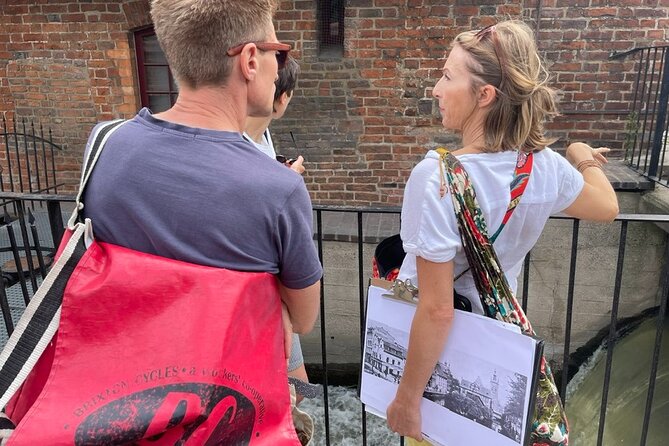
Old Gdańsk makes more sense with street-level architecture. I really like how Agnieszka connects buildings to how the city worked, and I like the old photos and details that explain what you are seeing. It is a private walk with an architect-guide in English, and it stays focused on the places you will actually stand in.
One thing to plan for: parts of this area involve stairs and tower climbs, and not every museum stop is included in the price. If you have a tight schedule, you will also want to time your visit around major church-clock moments.
Because the tour runs about 1.5 to 4 hours, it can feel either quick or very thorough depending on your questions and which optional interiors you choose.
In This Review
- Key highlights you can count on
- Why an architect-guide makes Old Gdańsk click
- Price and value for a private group up to 7
- Meeting at Ratusz Staromiejski and how the walk keeps moving
- Ratusz Starego Miasta: city hall, Radunia Canal, and Teutonic context
- The Great Mill and the Amber Museum add-on you can plan
- The turret-clock church: optional, but a star for strong legs
- From the highest medieval fortification tower to the Main Town shift
- Wielka Zbrojownia (Great Armoury): Renaissance wealth in one building
- St. Mary’s Church: the biggest brick church and noon chimes
- Mariacka Street and Brama Mariacka: walking through merchant time
- Green Gate and the Great Market zone with Artus Court interiors
- Uphagen’s House peek and ending at Prison Tower
- Tickets and optional museum time: how to choose without wasting hours
- Practical tips for a smoother Old Gdańsk day
- Should you book this private Old Gdańsk architect walk?
- FAQ
- How long is the Private Walking Tour of Old Gdańsk?
- How much does the tour cost?
- Is pickup available?
- Is the tour private?
- What language is the tour offered in?
- What is the meeting point and where does the tour end?
- Do I need to buy tickets for the stops?
- Is a mobile ticket used?
- Are service animals allowed?
- Can I cancel for a full refund?
Key highlights you can count on
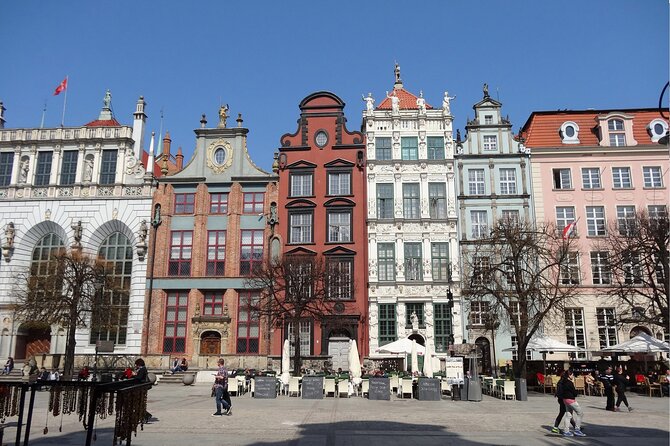
- Architect-guide explanations that connect design choices to Gdańsk’s real trading past
- Historic photo comparisons that show the city before World War II
- St. Mary’s Church and its astronomical clock chime at noon
- Tower-clock museum experiences (optional, but unforgettable if you’re up for it)
- A small private group (up to 7) that makes pace and questions feel natural
- Flexible museum add-ons like Amber Museum and Uphagen’s House, decided on the route
Why an architect-guide makes Old Gdańsk click
Old Gdańsk is gorgeous, but it can also feel like a pile of monuments unless someone explains the logic. This is why an architect-guide matters. Instead of only naming dates, Agnieszka points out how buildings were shaped by power, trade, and defense—then you see those ideas again as you keep walking.
A big plus: she uses visuals and old photos to show how the streets and structures looked before World War II. That changes the whole walk. You stop treating the Old Town like a museum and start reading it like a place that kept changing.
The tour is offered in English, and the reviews around Agnieszka highlight her energy, humor, and communication style. Even if your group is mixed in interests—architecture, history, or just wanting the best photos—this format usually works because she gives you both context and concrete details.
More walks through the Main Town and the Long Market in Gdansk





Price and value for a private group up to 7
The price is $264.35 per group (up to 7 people). That is not cheap if you go solo, but the value improves fast when you share it.
- With 7 people, you are effectively at about $38 per person.
- With 2 people, it is closer to $132 each, so you’ll feel the difference.
What makes the price feel more reasonable here is that many stops are exterior views or free-access church areas, so you are not paying again and again for basic entry just to learn. Also, you are buying time with a specialist guide who can explain design and city planning as you move from one landmark to the next.
If your priority is seeing the highlights efficiently and getting interpretation (not just sightseeing), this tends to be a strong use of money.
Meeting at Ratusz Staromiejski and how the walk keeps moving
You start at Ratusz Staromiejski, Korzenna 33/35 and end at Katownia Targ Węglowy, Węglowy 26. That matters because it is not a loop where you return to the same point. You slowly transition from the Old Town heart toward the Main Town gates and beyond.
Pickup is offered, and it’s near public transportation. Those are practical perks because you can plan around your arrival. The duration is flexible—about 1 hour 30 minutes to 4 hours—so it can work for short stays or longer, slower walks.
One practical note: wear shoes you trust. Even when most stops are quick (5–20 minutes), you are walking between them, plus you may choose tower steps later. If you have strong timekeeping curiosity, you’ll also want to time around noon for the big church chimes.
Ratusz Starego Miasta: city hall, Radunia Canal, and Teutonic context
Stop one is Ratusz Starego Miasta (Old Town City Hall), right beside the Radunia Canal. This is a smart opener because city hall is where governance, money, and civic identity meet.
Your guide will also connect the building to the Teutonic Order, which helps explain why Gdańsk’s architecture and political story are intertwined. The idea is not to memorize names; it is to understand why this kind of stone-and-brick civic building belongs here and what it signaled.
Admission is listed as free for this stop, and the time on site is short (about 12 minutes). You will usually feel the payoff because it frames what comes next: trade, power, and the city’s strategic position.
The Great Mill and the Amber Museum add-on you can plan
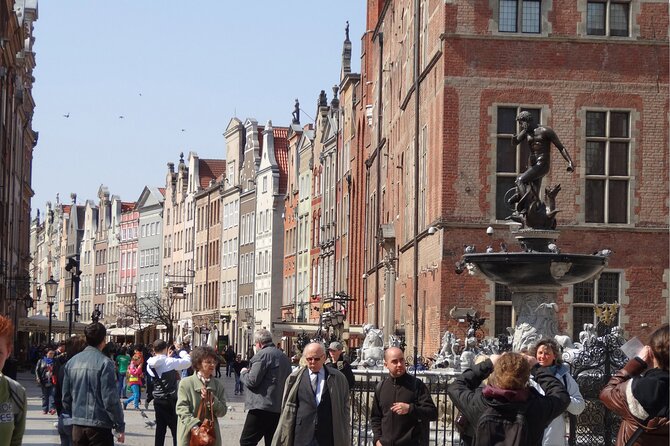
Next you head to The Great Mill (Wielki Młyn). The guide focuses on why this building mattered—Gdańsk’s role in grain, production, and supply chains—and then uses old photos to show what the surrounding area looked like before World War II.
Here’s the best practical tip: the Great Mill is also where you can find the Amber Museum, but it is not part of the tour. You’re strongly advised to visit it, and your guide will discuss doing it before the start if timing works.
So treat this like a menu:
- If you want pure architecture and walking, you can keep this stop light.
- If you want more museum time, plan the Amber Museum as a pre-tour stop so you don’t rush later.
This is one of those moments where you can tailor the day based on what you enjoy.
More guided Gdansk tours along the Baltic coast
- Gdansk: Guided Round-Trip Cruise to Westerplatte
★ 4.3 · 865 reviews - Gdansk: City Sightseeing Tour by Golf Cart/Buggy Guided Tour
★ 4.9 · 510 reviews - Gdansk Guided City Cruise on Historical Polish Boat
★ 4.5 · 230 reviews - Gdańsk: City Sightseeing Tour by Buggy/Golf Cart LIVE GUIDED 1H
★ 5.0 · 208 reviews
The turret-clock church: optional, but a star for strong legs
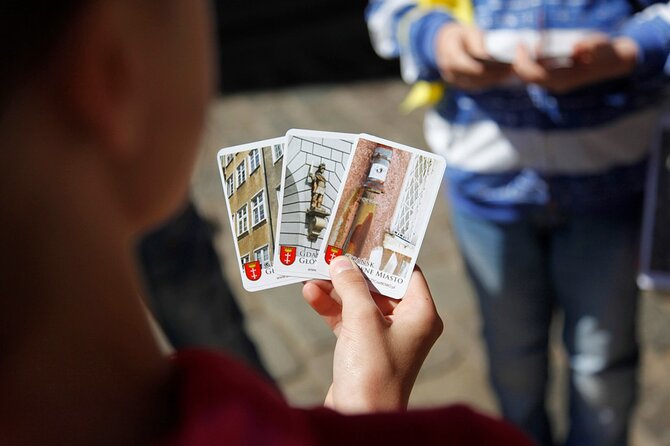
The next church stop is still active and includes a Museum of Turrets Clocks in the tower. This is the kind of detail that makes Gdańsk feel different from other Baltic cities: timekeeping as a technical and cultural obsession.
Important reality check: the museum is in the tower, and it calls for strong legs if you actually go up. The museum is described as housing centuries-old time-keeping devices, featuring the biggest concert carillon in Poland, and even including the world’s first pulsar clock.
This museum is not part of the tour, and it is something you discuss with your guide on the day. If you love clocks, engineering, or unusual museum themes, you’ll likely want it. If stairs are a problem, you can still enjoy the church area while skipping the tower visit.
From the highest medieval fortification tower to the Main Town shift
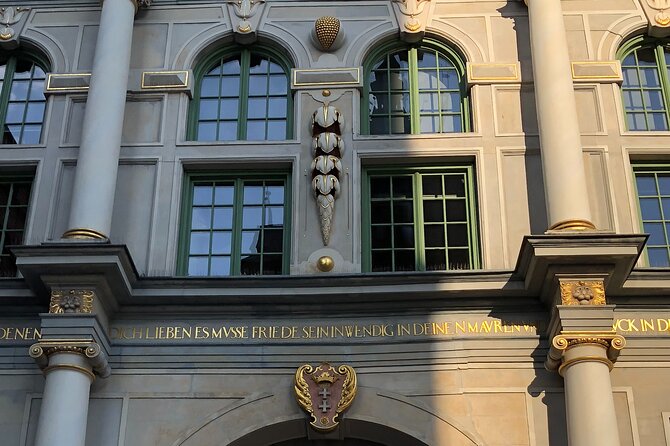
Then you move toward the highest of the towers of the medieval fortifications of the Main Town of Gdańsk. This stop does something more than add another view: it marks a transition.
Leaving the Old Town, you start discovering the broader “Main Town” and its scale. A good guide makes that shift feel meaningful, not just directional. You should come away with a better sense of how far the city’s influence reached and why the fortifications mattered.
The practical upside here is that higher-ground viewpoints help you orient your mental map. You stop feeling like you’re wandering and start recognizing where the city’s different zones connect.
Wielka Zbrojownia (Great Armoury): Renaissance wealth in one building
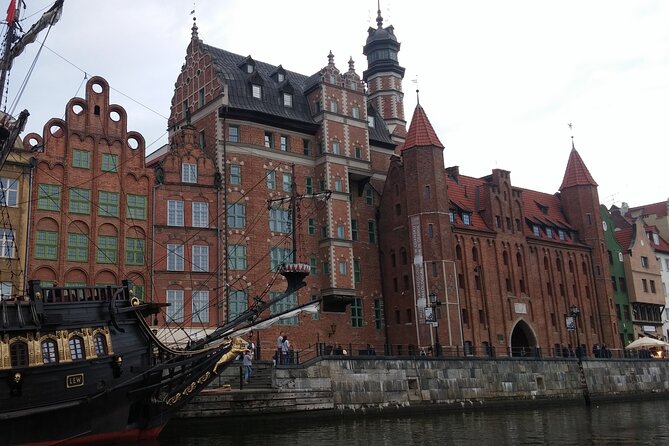
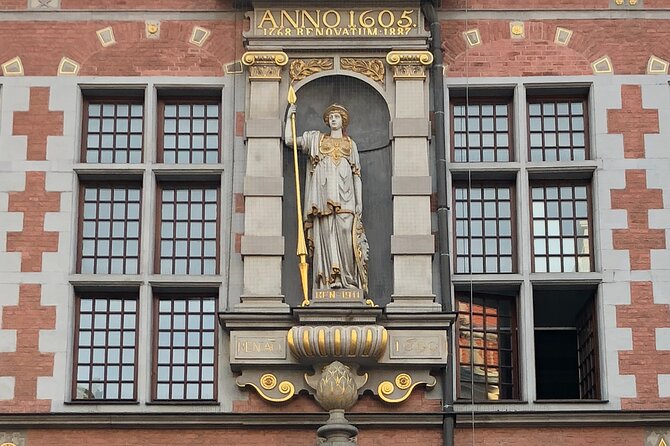
Stop 3 is the Great Armoury (Wielka Zbrojownia). Architecturally, it’s a strong contrast point. You look at a structure designed for arms and power, yet it also communicates Renaissance wealth through its look and scale.
The tour keeps this stop short (about 5 minutes) and notes it is free to see. The building now houses the Academy of Fine Art, and it sometimes opens to the public during students’ exhibitions.
If you happen to visit during an open window, it can add a layer of modern life to a historic structure. Even when you only see it as an exterior or quick interior peek, it works because it connects city wealth to design choices.
St. Mary’s Church: the biggest brick church and noon chimes
Now you reach one of the headline stops: St. Mary’s Church. It is described as the biggest bricks church in the world, and that alone is reason enough to pay attention to how the space feels.
The big reason you should plan your timing: it is the site for a huge 15th-century astronomical clock, and the church chimes every day at noon. If your tour overlaps with midday, this moment can become a highlight you remember for the sound as much as the architecture.
Admission is listed as free for this stop, and the time on site is about 15 minutes. That may sound short, but if the noon chime is near, you get exactly what you need: the clock’s presence and the experience of hearing it.
If you are not there around noon, you can still enjoy the church and the clock, but it will feel more like seeing a star feature than hearing it do its daily routine.
Mariacka Street and Brama Mariacka: walking through merchant time
After St. Mary’s you head to Mariacka Street (Ulica Mariacka), a charming stretch where you can really feel the old ambiance. The tour gives this one about 20 minutes, which is the right amount of time for slow walking, photos, and letting the street level story work on you.
Next, you pass Brama Mariacka, where the guide talks about maritime trade. This is a clever way to break the day into themes: you move from church and city center identity into trade routes and how ships made wealth.
Even though those points are not museum entries, the guide’s narrative is what makes them worth stopping for. You should leave with a better picture of why Gdańsk looked the way it did and how trade shaped the city’s priorities.
Green Gate and the Great Market zone with Artus Court interiors
Then you reach Green Gate (Brama Zielona), which acts as an entrance toward the Great Market area—basically the place where deal-making and daily commerce happened.
This stop is listed as about 10 minutes with free entry. It sets you up for the next part: this area has extra layers you may want to explore on your own.
Your guide points out spots like Artus Court, a historical meeting place for merchants that today is presented as an astonishing museum of history and art, plus areas connected to the Main Town Hall and its interiors. These are the kind of places where having someone explain what you’re looking at saves time and prevents you from missing the important details.
Even if you don’t go inside, just knowing what the building was for changes your interpretation of the façade.
Uphagen’s House peek and ending at Prison Tower
Stop 8 is Uphagen’s House – Museum of Gdansk. This is described as a peek inside that gives you a quick journey back in time. Your guide lets you decide if you want more, and admission is listed as not included.
This works well because you can match the experience to your energy. If you want more rooms and interior detail, you can treat it as a continuation. If you prefer the street-level architecture and views, you can keep it light.
Finally, the walk ends at the Prison Tower, where the tour focuses on where some lives ended. Admission is listed as not included here too. Ending on this note is powerful because it connects the city’s prosperity and order to the harsher side of civic life.
It also provides a clear mental bookend: from commerce and clocks to consequences and confinement.
Tickets and optional museum time: how to choose without wasting hours
A key thing to understand is that this walk mixes free stops with optional museum add-ons. Some entries are explicitly not included, and others are described as things you discuss on the route.
Here are the choices you may face:
- Amber Museum at the Great Mill: strongly advised, but not included. Plan ahead if you want it.
- Museum of Turrets Clocks: in the tower of a church; optional and discussed, and it’s the one that strongly suggests strong legs.
- Uphagen’s House: a peek is part of the experience, but the deeper museum visit is optional (not included).
- Prison Tower: included as the ending conceptually, but entry is not included.
My practical advice: decide early what you want most—architecture and street flow, or extra museum time. If you try to do everything, you can lose the calm pacing that makes the guide’s explanations work.
Practical tips for a smoother Old Gdańsk day
Old Gdańsk rewards calm walking and smart timing. Here are a few ways to make the experience feel effortless.
Time your day for the noon chimes. If you can, aim for your St. Mary’s Church moment around midday to catch the astronomical clock chime.
Bring a little flexibility. The tour can range from about 1.5 to 4 hours, and the guide discusses optional tower and museum stops. That means your “plan” should be a “direction,” not a rigid checklist.
Use good shoes. The turret-clock tower museum is specifically flagged as requiring strong legs, and you’re still doing a walking route even if you skip it.
Photograph with context. Since the guide uses old photos, you’ll get more from your camera if you take pictures that match those viewpoints. You’ll feel the before-and-after contrast more clearly later.
Should you book this private Old Gdańsk architect walk?
Book it if you want Old Gdańsk explained through buildings, design, and the working logic of the city. This is especially worth it when:
- you like architecture and want more than dates and dates-only facts
- you enjoy unusual stops like clock museums and maritime trade context
- you are traveling with a small group (up to 7) and can split the group price
Consider a different format if you:
- want only museums with fixed ticketing and no in-route choices
- need a fully step-free route (the tower museum is flagged as a strong-legs option)
- have almost no flexibility for timing around noon
If your ideal day is walking, listening, and suddenly understanding why the city looks the way it does, this private Old Gdańsk tour is a strong fit.
FAQ
How long is the Private Walking Tour of Old Gdańsk?
The tour runs about 1 hour 30 minutes to 4 hours, depending on how the route and optional stops work out.
How much does the tour cost?
It costs $264.35 per group, up to 7 people.
Is pickup available?
Yes, pickup is offered.
Is the tour private?
Yes. It is a private tour/activity, and only your group participates.
What language is the tour offered in?
It is offered in English.
What is the meeting point and where does the tour end?
You start at Ratusz Staromiejski, Korzenna 33/35, 80-001 Gdańsk, Poland, and end at KatowniaTarg Węglowy 26, 80-836 Gdańsk, Poland.
Do I need to buy tickets for the stops?
Some key places are listed as free (like the city hall exterior stop, Great Armoury, and St. Mary’s Church). Other museum entries are not included, such as the Amber Museum and Uphagen’s House, and the turret clock museum and Prison Tower are discussed as optional.
Is a mobile ticket used?
Yes, the tour includes a mobile ticket.
Are service animals allowed?
Yes, service animals are allowed.
Can I cancel for a full refund?
You can cancel for a full refund up to 24 hours in advance of the experience’s start time.
More Guided Pomerania Day Tours
- Gdańsk City Sights & History Guided Walking Tour in English★ 4.8 · 876 reviews
- Gdansk: Guided Round-Trip Cruise to Westerplatte★ 4.3 · 865 reviews
- Gdansk: City Sightseeing Tour by Golf Cart/Buggy Guided Tour★ 4.9 · 510 reviews
- Gdansk Guided City Cruise on Historical Polish Boat★ 4.5 · 230 reviews
- Gdańsk: City Sightseeing Tour by Buggy/Golf Cart LIVE GUIDED 1H★ 5.0 · 208 reviews
More Tour Reviews in Gdansk
- Gdańsk City Sights & History Guided Walking Tour in English★ 4.8 · 876 reviews
- Gdansk: Firearm Shooting Experience with Instructor★ 4.8 · 866 reviews
- Gdansk: Guided Round-Trip Cruise to Westerplatte★ 4.3 · 865 reviews
- Gdańsk: Sightseeing EcoCruise around the Old Town of Gdansk★ 4.6 · 719 reviews
- Main Town Gdańsk Walking Tour★ 5.0 · 644 reviews
More Main Town & Long Market Walks
- Gdańsk City Sights & History Guided Walking Tour in English★ 4.8 · 876 reviews
- Gdańsk: Sightseeing EcoCruise around the Old Town of Gdansk★ 4.6 · 719 reviews
- Main Town Gdańsk Walking Tour★ 5.0 · 644 reviews
- Discover Gdansk Walking Tour★ 5.0 · 495 reviews
- Historic City Center Tour Gdansk in German★ 4.6 · 455 reviews
Still deciding? Here are more Gdansk tours and Pomerania day trips we have written up



Gdansk Old Town & Main Town Walking Tours, compared.
 ★ 4.8Gdańsk City Sights & History Guided Walking Tour in EnglishFrom $26876 reviews
 ★ 4.6Sightseeing EcoCruise around the Old Town of GdanskFrom $19719 reviews
 ★ 5.0Main Town Gdańsk Walking TourFrom $26644 reviews
 ★ 5.0Discover Gdansk Walking TourFrom $6495 reviews
 ★ 4.6Historic City Center Tour Gdansk in GermanFrom $26455 reviews
 ★ 4.9Old Town Private Walking Tour with Legends and FactsFrom $107245 reviews
 ★ 4.5Gdansk Old Town 2-Hour Walking TourFrom $16794 reviews
 ★ 4.5Sunset on the Shipyard and Old Town Evening CruiseFrom $2586 reviews
Browse the lists this tour appears in